News and Reviews
|
|
2012
Painting
Featured in Museum Publication
The Geometric Unconscious: A Century of
Abstraction, (color
illus. Action Potential, 2005)
Jorge
Daniel Veneciano, ed., University of Nebraska Press, Lincoln and London, 2012.
xiv
The
Sheldon Museum of Art, Lincoln, Nebraska
Publication Award
Briar Cliff Review, (color illus. Self Recognition 1, 2009)
Briar
Cliff University, Sioux City, Iowa.
Vol.
24 p. 79
2007
Painting
Featured in Textbook
The Aleph
©
Marjorie Mikasen 1996
pp.
382-3 2006
Newspaper
Feature Excerpt: .
. . visually, the rehanging works both as a
showcase for some of Sheldon's best work and some of its newest purchases,
including paintings by Lincoln artists Dan Howard and Marjorie Mikasen, and
as an illustration of the connection between art and identity. . . . Newspaper
Feature Excerpt: .
. . I write my list on the flight to Lincoln, noting information I need
before presenting the Chamberlain on Monday to the Sheldon Board. Dan and I
will present the David Smith, a Weldon Kees work on paper, a painting by
Marjorie Mikasen and a monotype by a New York artist. . . . Artblog
Review by
Libby Rosof, fallonandrosof.com, May 17 Excerpt: . . . Marjorie
Mikasen's geometric forms made me think of slants of light falling on a
church congregation. . . . Newspaper
Feature Excerpt: .
. . "Foci" is a treat with the intricate patterns and compelling
interlocked colors capturing the eye and sending it shooting around the
paintings. . . This captivating show shouldn't be
missed. But be sure that you have some time when you stop by to see her
paintings. Their complexity demands that you actually look at them and follow
the shapes and lines and follow them and follow them and follow them. Newspaper
Feature Excerpt: . . . confronting
Mikasen's colorfully intense abstractions, a viewer is more concerned with
appreciation and analysis, and it is her adherence to an evolving singular
expression that provides one of the keys and clues for interpretation. Her work is challenging but viewer
friendly. It is neither evasive
nor patronizing .
. . . Catalogue
Essay by
Roberta Fallon, February Excerpt: .
. . Like
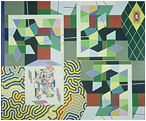
an illustration for a journal article on chaos theory, Marjorie Mikasen's
"Proprio" displays a
fractured microscopic or macroscopic stew. The piece has a maze-like
structure (few points of entry, many dead-end avenues and a center that's
hidden). Is it a cubistic portrait of our complex universe? A graphic display
of data processed by a Cuisinart? While "Proprio" suggests the
chaotic, the arrhythmic and the dysfunctional, its lines, shapes and colors
have somehow achieved harmonious interplay. Indeed the piece seems to
celebrate the natural world and its crystalline, multi-faceted beauty. . . . 2005
Magazine
Feature Proprio,
acrylic on canvas, 42" x 42", 2002 New
Kouros, acrylic on canvas, 52" x 48", 2003 Rasa
3, acrylic on canvas, 16" x 32", 2000 Excerpt: Ask anyone to list the characteristics of the typical
artist and you're likely to get descriptors like: free-spirited, spontaneous,
daydreamer, and disinterested in schedules, orderliness, business or details. Such right-brained characters probably belong in the
category of great American myths; or, if they do exist, would not be likely
to achieve much career success. One thing is for certain: the left side of Marjorie
Mikasen's brain functions extraordinarily well. She spends every day in her perfectly ordered,
light-filled studio, producing crisp, colorful, geometric paintings that
delve into worlds of science, geometry, mythology, philosophy, psychology and
literature. . . . Magazine
Feature Excerpt: . . . Marjorie L. Mikasen's painting, "Rasa 3" (
rasa is Hindu for "the essence
of"), is what the artist calls a "stereopair," defined as
a "side-by-side image that is meant to be viewed using free vision
or cross-eyed vision." Part of an ongoing series, "Rasa
3," evenly divided into two sections, gives us a pair of images to
focus on and merge, their translucent architectonic structures based on
a profusion of rectangles and triangles. Rising against a field
that is partially patterned with curvilinear forms, "Rasa" suggests
a schematic plan for a futuristic complex and demonstrates
Mikasen's deep involvement with the physiological and psychological processes
of perception. . . . 2004
Press
Release The Avery Hall Art Selection Committee,
which conducted the search for art for this newly renovated structure at the
University of Nebraska-Lincoln, is pleased to announce the winners of this
competition. The following is a list of the artists whose work will be
featured (listed by name, media of work purchased, and artist's home
location): 2003
Newspaper
Feature Excerpt: 2002
Magazine
Feature
Excerpt: 2001
Review: The
Nature of Both: Stereopair Paintings, The Haydon Gallery Color
Illustrations by Marjorie Mikasen: Embodied
Light, acrylic on canvas, 16" x 32", 1999 Gnostic
Unit #1, acrylic on canvas, 12" x 20", 2000 LINCOLN
- Marjorie Mikasen worked three years to prepare for her
exhibition, The Nature of Both:
Stereopair Paintings, at the Haydon Gallery. Now, viewers must do some
work. The focus of the show is a series of eight
hard-edge paintings Mikasen calls "stereopairs." Each painting has
two images - different, but sharing a common template - divided by a vertical
line. By focusing your vision on your index finger aligned with the center
line, then moving it toward your face, the two sides will begin to fuse in a
third image that appears to be three-dimensional with some movement thrown in
for good measure. For those who have trouble with this
"free vision" or "cross-eyed vision," the gallery has
provided a stereoviewer that does the work for you - but, of course, you lose
the drama of seeing the large-scale, original image. The three-dimensionality of the images is
reminiscent of holography - something that seems to most of us a commercial
trick. So does that bring Mikasen's works closer to gimmickry? I don't think so, for a couple of reasons. First, whether seen stereoscopically or not,
these images hold up artistically. Despite their precision, her terse balance
of architectonic, figurative and abstract forms is dynamic. Mikasen also uses
color in a particularly engrossing way. Using a broad range of hues, she
manipulates value and intensity in each painting, yielding entirely different
effects from piece to piece, especially when fused. Second, Mikasen's paintings open a number of
avenues of interest. In ways, she has followed in the footsteps of
Frank Stella and others who moved from hard-edge abstraction to
three-dimensional work. Yet, the allure to Mikasen has been the illusion of
the third dimension. For her work, there is an interplay among the degrees of
spatial illusion that continue to emerge as her work is viewed. Mikasen uses a computer to aid with design of
her images, then transcribes to canvas. This balance of technology and
handwork allows for a degree of spontaneity while assuring exactitude. It
also suggests a number of questions regarding the place of technology in
contemporary art. "This series is about the dynamic
interplay of '2,' " Mikasen says. "I am using this device as a
visual metaphor to explore aspects of splitting, doubling, occlusion,
opposition, creation and wholeness. " Try to see The
Nature of Both: Stereopair Paintings. There is a lot to look at and you
have to admire Mikasen's organization and obvious hard work in preparing for
this exhibition. Mikasen received the Savoir Faire Award from
the National Acrylic Painters Association of Great Britain and the United
States in 1998. Her work was shown in the 14th
Annual ARTstravaganza Juried Exhibition at Hunter Museum of American Art
in Chattanooga, Digital Elements
National Art Exhibition at St. John's University Gallery in New York, Making Space: Perspectives on Spatial
Relationships at Valencia Community College in Orlando and YLEM: Artists Using Science and Technology
at Gallery on the Rim in San Francisco. She was interviewed on Open Studio on Voice of America TV in Washington, D.C., by Branko
Mikasinovich and on Dialogue on the
Arts on Cox Cable TV in Omaha by Kyle MacMillan, former art critic for
the Omaha World-Herald. The
Nature of Both: Stereopair Paintings will be on display
through May 26. The Haydon Gallery is located at 335 North 8th St. in
Lincoln's Historic Haymarket District. The Haydon is open from 10 a.m. to 5
p.m. Tuesday through Saturday. 2000
Television
Interview From
the Press Release:
Lincoln
artist Marjorie Mikasen will be interviewed on a Voice of America television
broadcast in June. the five minute interview will be taped in Washington DC
and aired June 16, 2000, to a European audience comprising millions of
viewers in a geographic area from Great Britain to Turkey. The interview, conducted by Journalist /
Broadcaster Branko Mikasinovich, will include discussion of her artistic
background, recent exhibitions, the content and technique of her art, current
and future projects, and will show examples of her work. Voice of America programs originate from
its headquarters building in Washington, DC, located at 330 Independence Ave,
SW, where broadcasters produce newscasts, features, Americana programs,
English-teaching programs, and music shows in 53 languages. The VOA has
broadcast United States, regional and world news to listeners around the
globe for over 57 years. Featured
Artist 1999
Review:
Computer Generated Art Exhibition, Appleton Art Center Excerpt: © Marjorie
Mikasen, All Rights Reserved |